
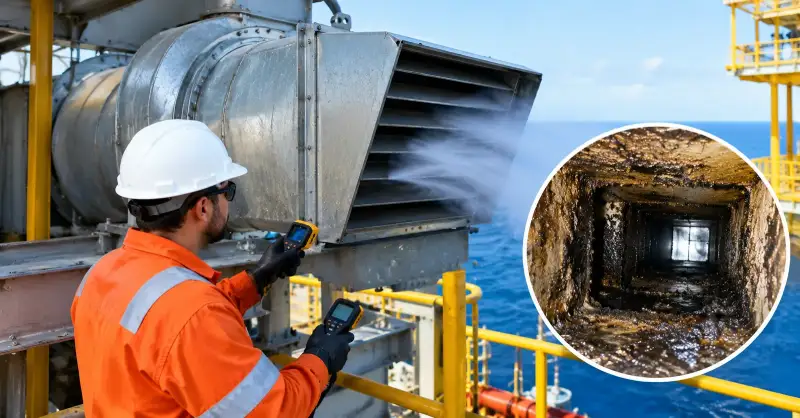
When an exhaust system starts pulling less air than it used to, the fan is usually the first suspect. Sometimes that’s fair. But just as often the restriction is somewhere along the ductwork itself, tucked away where nobody thinks to look. In an offshore galley, cooking vapor carries grease into the exhaust system every single shift, and some of that grease inevitably settles on the internal surfaces as air moves through the duct. It’s a slow process. That’s really the whole problem with it. A system keeps running while deposits quietly build up inside, and airflow can be noticeably worse long before anything looks like an actual failure.
Why Grease Buildup Can Reduce Airflow
Air moves best through a clear path. Once grease starts coating the smooth interior of a duct, that path gets narrower, and heavier deposits eat further into the space available for air to move through. It rarely announces itself. The fan is still spinning, the hood is still pulling, and from where the cooks are standing, everything looks fine. But the system has lost some of the capacity it had when it was clean, even if nobody’s noticed yet. That said, grease isn’t automatically the culprit every time airflow drops. Worn fans, dirty filters, stuck dampers, poor duct design, and plain mechanical wear can all produce the same symptoms. So a drop in airflow is really a prompt to go investigate, not a diagnosis on its own.
What Offshore Maintenance Teams Should Look For
Most of the useful clues are unremarkable on their own. A technician who’s around the same equipment week after week tends to pick up on a shift before anyone else does, mostly because they have a feel for how things are supposed to sound and smell and run. Worth keeping an eye on:
- Airflow that feels weaker at the exhaust points
- Heavier residue collecting around anything accessible
- Cooking odors that hang around longer than they should
- Fan behavior that seems a bit off
- Visible deposits near hood or duct access panels
- Complaints about heat or moisture that keep coming back
- Ventilation that just doesn’t feel as strong as it did at the last inspection
None of these on its own proves there’s grease built up inside the duct. But when a few of them show up together, that’s usually worth a closer look rather than a shrug.
Why Internal Grease Deposits Matter
This isn’t just a tidiness issue. Grease is combustible, and once it accumulates inside ductwork, it raises real fire-related concerns within the exhaust system. That’s true of any commercial kitchen, but offshore facilities add another layer to it, since equipment, crew, accommodation spaces, and operational systems are all packed into a relatively tight footprint. That’s a big part of why regular grease exhaust system cleaning belongs in ongoing maintenance planning rather than something people arrange only once the buildup gets bad. Clearing that residue out keeps the pathway clean, and it also gives maintenance staff an actual chance to spot conditions that would otherwise stay hidden behind the grease.
Why Offshore Exhaust Maintenance Takes More Planning
An offshore facility rarely lets a crew pick the easiest time or the simplest method for a job. Access is often limited, equipment usually needs to keep running, and cleaning work has to be worked around people, machinery, safety procedures, and whatever else the facility has going on that week. Ductwork can also run through sections that are genuinely hard to reach or inspect directly. None of that is a minor detail. A cleaning method might be technically sound on paper, but it only matters if it can actually be carried out safely, in that specific environment. So exhaust maintenance offshore has to be planned around the realities of the facility. It’s not something you can treat the same way you’d treat cleaning a small commercial kitchen on land.
Is Cleaning the Hood Enough?
The hood gets most of the attention because it’s the part everyone can see. Fair enough. But the duct behind it tells a different story. Grease-laden air keeps traveling well past the hood, and deposits can form in sections of ductwork and around components nobody sees on a routine walk-through. Industrial kitchen hood cleaning absolutely has its place in a maintenance routine, but cleaning the hood alone doesn’t tell you anything about the condition of the rest of the exhaust pathway. If airflow has changed, or there’s reason to think buildup is significant, the whole system needs a look. Focusing only on what’s easy to reach can leave the actual problem sitting untouched further down the line.
When Should Airflow Changes Be Investigated?
There’s no single cleaning schedule that works for every offshore installation, and it would be misleading to pretend otherwise. A heavily used galley generates a very different contaminant load than a facility with lighter cooking activity, and things like system design, operating hours, environmental conditions, and maintenance history all affect how fast deposits build up. We’d rather look at the actual condition of the system, alongside how it’s being used, than lean on a calendar date and hope it lines up. A few good reasons to evaluate the system now, rather than wait for the next scheduled window:
- Airflow that’s been gradually dropping off
- Odors that stick around longer than they used to
- Residue that’s becoming more visible over time
- Inspection findings that show real accumulation
Make Exhaust Cleaning Part of Preventive Maintenance
Waiting until an exhaust system starts performing badly is rarely the smart move. By that point, deposits tend to be heavier, access gets more complicated, and the work becomes harder to fit into an operating schedule without disrupting something else. Planned grease exhaust system cleaning can be built into a preventive maintenance program instead, based on how the facility is actually operating rather than a generic interval. Keeping decent records helps too. Worth tracking over time:
- Previous cleaning dates
- Inspection notes from each visit
- Spots where buildup tends to show up repeatedly
- Any changes in system performance between inspections
Together, this gives maintenance teams something to work from, so patterns become visible over time rather than getting rediscovered from scratch every visit. That turns cleaning into a planned part of the maintenance program, rather than something that only happens once a problem forces the issue.
Conclusion
Poor airflow is worth taking seriously, but it deserves a technician’s mindset rather than an assumption that one particular cause is behind it. It might be grease restricting the duct. It might be mechanical, operational, or something else in the ventilation system entirely. What matters is investigating the change while the system is still running, before a minor maintenance concern turns into a much bigger disruption. For offshore facilities dealing with reduced airflow, visible deposits, persistent odors, or any other exhaust concerns, gvms1 can help assess the condition of the system and provide professional cleaning services suited to the demands of offshore operations.
FAQs
1. Can grease buildup cause poor exhaust airflow?
Yes, accumulated grease can restrict duct space and reduce the efficiency of exhaust airflow.
2. What are common signs of grease buildup in offshore exhaust ducts?
Reduced airflow, persistent odors, visible residue, and changes in fan performance can indicate possible buildup.
3. Is cleaning the exhaust hood enough?
No, the connected ductwork and other exhaust components should also be considered when buildup is suspected.
4. How often should offshore exhaust systems be cleaned?
Cleaning frequency depends on cooking activity, system design, operating conditions, and the amount of contaminant buildup.
5. Why is preventive exhaust maintenance important offshore?
Planned maintenance helps address buildup early, support system performance, and reduce unexpected operational disruptions.
