
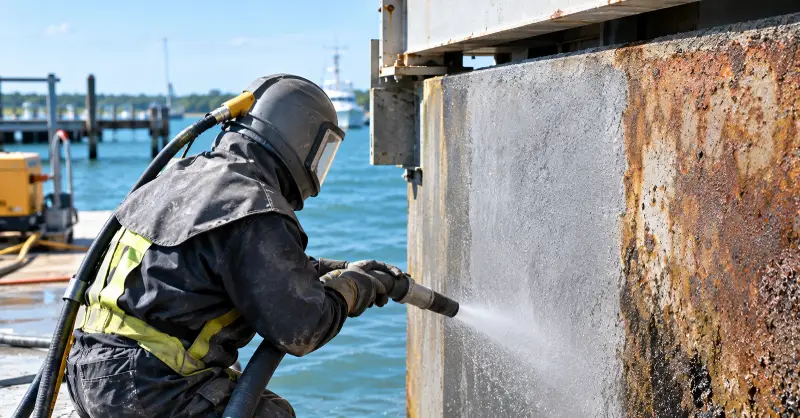
A coating is only as good as the surface it sits on. Work may be hampered before the first coat is even put on by rust, old coatings, oil, dust, loose scale, and other contaminants. That counts in the marine/industrial world. Saltwater, moisture, chemicals, and constant exposure to the elements can take a heavy toll on unprotected metal.
At GVMS 1, LLC, we believe that surface preparation is an important part of corrosion repair and prevention. Our work covers marine structures, industrial facilities, storage tanks, piping, steel equipment, and other assets where corrosion protection matters.
The Work Begins Before the Coating
Applying a fresh coating over a deteriorated surface rarely solves the underlying problem. Rust and failed coatings need to be removed first. Otherwise, the new protective system is being placed over material that has already lost its integrity.
Our preparation methods vary according to the project. We use blasting, pneumatic air tools, needle guns, chipping equipment, and other mechanical methods to remove rust, loose scale, deteriorated coatings, and surface contaminants. After that, the surface is cleaned to remove dust, oil, and remaining residue.
It is straightforward work, but it has to be done properly. Corrosion-resistant coatings need a clean, prepared surface if they are going to provide the protection expected from them.
Preparing Surfaces for Long-Term Protection
Once the surface has been cleaned and prepared, additional treatment may be necessary. On marine structures, our process can include saltwater treatment solutions and approved rust-inhibiting chemicals. These treatments help stabilize corrosion that may remain in pits or surface irregularities.
We then apply a primer as the base protective layer, followed by a black topcoat or another coating specified for the project. The coating system creates a protective barrier between the prepared surface and the environment.
The same principle applies to tank restoration. Our tank liner work includes removing failed liner material, abrasive blasting, cleaning debris and contaminants, preparing the surface profile, and inspecting the exposed surface before applying a new liner.
The preparation determines what the coating has to work with. That is why it deserves as much attention as the coating itself.
Protecting Pipes, Tanks, and Industrial Equipment
Corrosion does not affect every asset in exactly the same way. Pipes, tanks, marine structures, and steel equipment can all have different exposure conditions and maintenance requirements.
Our pipe restoration services include removing rust and corrosion, preparing the surface mechanically, removing contaminants, and applying protective paint systems and corrosion-resistant coatings. The purpose is to restore the surface and provide protection against the conditions contributing to deterioration.
We also provide tank painting services. Our work includes removing failed coatings and rust, pressure washing, cleaning, applying primer, and completing durable topcoat work. Each stage contributes to the condition of the finished coating system.
Our broader industrial coating and insulation capabilities also include fire-rated thermal insulation. We provide insulation designed to help prevent heat transfer while resisting, containing, or slowing the spread of flames. HVAC fire damper insulation is another service we provide for fire protection applications.
When Access Is Part of the Challenge
Some structures are simply difficult to reach. Offshore equipment, elevated areas, confined spaces, and other hard-to-access locations require a different approach.
Our offshore rope-access blasting and painting services allow us to reach these areas while carrying out the same essential preparation and coating work. We remove rust, deteriorated coatings, marine growth, and contaminants before applying primers and protective coatings.
The access method may change, but the basic principle does not. The surface still needs to be properly prepared before the protective system is applied.
Final Words
At GVMS 1, LLC, we do not view surface preparation as a quick step before painting. It is part of the actual corrosion protection process.
Removing rust, failed coatings, and contaminants gives corrosion-resistant coatings a properly prepared foundation. When combined with our industrial coating and insulation services, protective coatings, rust-inhibiting treatments, and restoration work, surface preparation helps us address both immediate repair requirements and the continued protection of industrial and marine assets. Good coating work starts long before the roller, brush, or spray equipment comes out. The condition of the surface sets the stage for everything that follows.
FAQs
1. Why is surface preparation important before applying corrosion-resistant coatings?
Surface preparation removes rust, failed coatings, oil, dust, and contaminants so protective coatings can perform properly.
2. What surface preparation methods does GVMS 1, LLC use?
We use blasting, pneumatic tools, needle guns, chipping equipment, mechanical preparation, cleaning, and other project-specific methods.
3. Where can corrosion-resistant coatings be applied?
They can be used on marine structures, pipes, storage tanks, steel equipment, and other industrial assets exposed to corrosion.
4. Does GVMS 1, LLC provide industrial coating and insulation services?
Yes. Our services include protective coatings, fire-rated thermal insulation, HVAC fire damper insulation, and corrosion-control applications.
5. How does proper preparation improve coating performance?
A properly cleaned and prepared surface gives the coating a stronger foundation for long-term protection against moisture, salt, chemicals, and environmental wear.
