
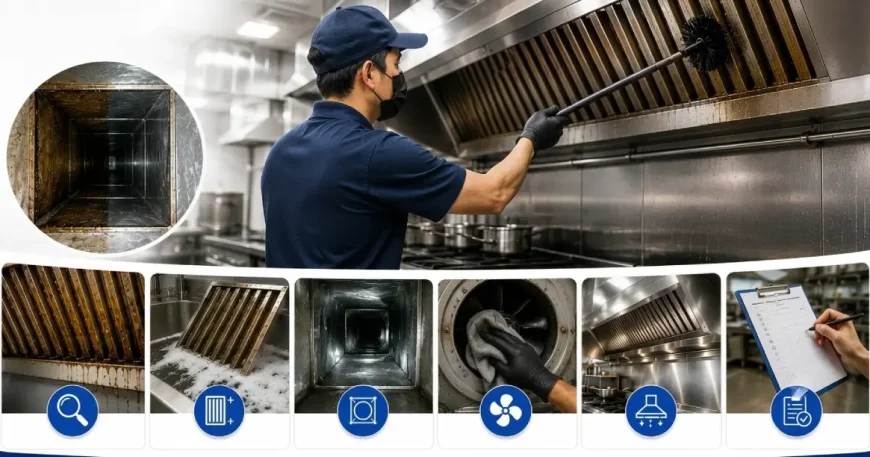
A galley rarely gets a quiet day on an offshore vessel or industrial facility. Meals are prepared, cooking equipment runs for long stretches, and the exhaust system keeps pulling heat, smoke, grease, and airborne particles away from the work area. Some of that material is caught by filters, but not everything stops there. Residue can make its way into hoods, ductwork, fans, and other parts of the ventilation system. The areas that are easiest to see are usually the ones that get the most attention, while the less visible sections can quietly collect buildup over time.
This guide looks at what professional galley exhaust cleaning actually involves, which parts of the system deserve attention, and what facility teams can expect when cleaning becomes part of a regular maintenance routine.
What Does Professional Galley Exhaust Cleaning Include?
Professional galley exhaust cleaning services are not limited to cleaning the surface directly above the cooking equipment. We start by looking at the system as a whole. That means considering the hood, filters, accessible ductwork, fans, and other connected components before deciding how the work should be approached. This matters offshore because no two installations are necessarily the same. Access can be tight, equipment may be positioned in awkward places, and the cleaning process has to fit around the practical realities of the facility.
Cleaning the Hood and Filters
The hood is where much of the cooking-related residue first collects, so it is a natural place to begin. Filters deserve just as much attention. They sit directly in the path of air moving through the system and can become coated with grease and particles as the galley operates. During commercial kitchen hood cleaning, we work on the appropriate hood surfaces and filters rather than treating the visible face of the hood as the entire job. It is a small distinction on paper, but an important one in practice. A ventilation system is only as well maintained as the components that actually receive attention.
Reaching the Exhaust Ductwork
Ductwork tends to be forgotten because most of it is out of sight. That does not mean it is out of the cleaning picture. As cooking vapors move through the exhaust system, residue can settle along internal surfaces, particularly over long periods of regular use. We assess accessible sections of the ductwork and determine where cleaning is appropriate based on the system’s configuration and condition. The goal is to deal with the exhaust path rather than stopping at the first component that happens to be visible.
Paying Attention to Fans and Exhaust Components
The exhaust fan is another area of the system that should not be an afterthought. It is used to circulate air across the whole ventilation system. Other components can also build up residue during normal operation. We inspect eligible regions and clean accessible components where suitable, taking into account the equipment and working environment. Here is where experience counts. Cleaning industrial or offshore equipment is not just a case of putting a solution on and scrubbing until something looks clean. The method must fit the equipment, the location and the project.
What Should a Professional Cleaning Service Cover?
A thorough service should give facility teams a clear understanding of what has been addressed rather than leaving them wondering whether only the most obvious surfaces were cleaned. Depending on the system, the work may include:
- Assessing the hood, filters, ductwork, and related exhaust components
- Cleaning appropriate hood and filter surfaces
- Addressing accessible sections of exhaust ductwork
- Inspecting applicable fan and exhaust components
- Working carefully around nearby equipment
- Taking access, operating conditions, and facility requirements into consideration
These elements may appear simple, but they are what separates a full maintenance strategy from a quick superficial clean. That distinction is something to pay attention to in a busy offshore area.
Why Offshore Experience Makes a Difference
An offshore galley has its own set of practical challenges. Space may be limited, equipment can be tightly arranged, and access to certain sections of a ventilation system may take more planning than it would in a conventional commercial kitchen. Cleaning also has to fit within an operating environment where equipment and personnel cannot simply be moved aside for convenience. GVMS 1, LLC approaches these conditions with offshore and industrial maintenance in mind, allowing the cleaning process to be considered around the actual system rather than relying on a one-size-fits-all routine.
Making Cleaning Part of Routine Maintenance
Being able to clean up buildup before it becomes a bigger maintenance problem is valuable. The frequency of cleaning a system depends on numerous aspects such as the frequency of galley operation, the type of cooking done, the equipment used, and the environment around the installation. Regular commercial kitchen hood cleaning can also be part of a more extensive maintenance program, so facilities personnel can take a more predictable approach to managing the exhaust system rather than considering the cleaning as a one-off.
Conclusion
A galley exhaust system has a fairly simple job on the surface, but it relies on several connected components working together day after day. Through this guide, we have covered the main areas that professional cleaning can address, from hoods and filters to accessible ductwork, fans, and related exhaust components, along with the practical considerations that come with offshore environments. If your facility is due for professional galley exhaust cleaning services, get in touch with our staff today to discuss your system and identify the cleaning method that suits your equipment, access needs, and operating schedule.
FAQs
What does professional galley exhaust cleaning include?
It covers assessing and cleaning the hood, filters, accessible ductwork, and fans as one connected system. This gives facility teams a clear picture of what’s been addressed, not just the parts that are easy to see.
Why does offshore experience matter for this type of cleaning?
Offshore galleys often have tight spaces and equipment arranged close together, so a one-size-fits-all approach doesn’t work well. Experienced teams plan the cleaning process around the actual system and environment.
How often should galley exhaust cleaning be done?
Frequency depends on how often the galley operates, the type of cooking, and the equipment used. Making cleaning part of a routine helps facility teams manage buildup proactively.
Is hood cleaning just about the visible surfaces?
No, a thorough service works on the appropriate hood surfaces and filters together, not just the outer face. This more complete approach supports better long-term system performance.
How do I get started with professional galley exhaust cleaning?
Simply get in touch with the team to discuss your system, access needs, and operating schedule. They’ll help identify the cleaning method best suited to your equipment and facility.
